

Quick answer: This Herbxmind guide covers cannabis pesticide test results COA with practical label, COA, ingredient, and responsible-buying checks for adult consumers.
Quick answer: To read cannabis pesticide test results on a COA, first match the certificate to the exact product form and batch, then identify the pesticide panel, the laboratory’s result legend, units, reporting limits, and any qualifiers. A “not detected” entry is meaningful only in the context of the method and threshold stated on that report. A COA is evidence about a specific tested sample; it is not a medical safety guarantee, a product recommendation, or a universal statement about all products or locations.
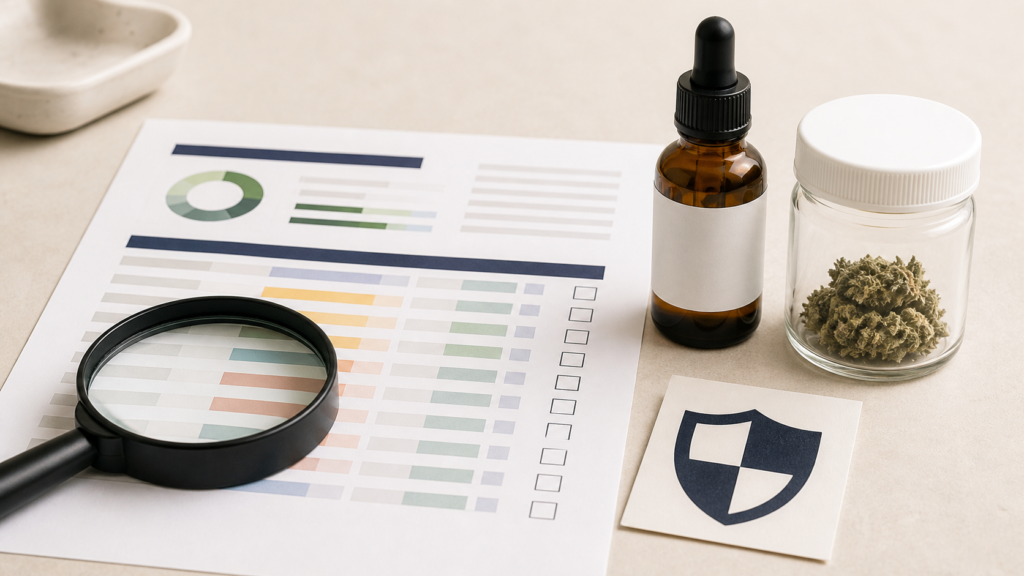
Pesticide tables can be dense: rows of abbreviated chemical names, numbers, flags, and laboratory terms. The useful approach is slower than scanning for a green badge or a single word. Begin with document identity, then read what the laboratory says it tested and how it reports results. This article helps adult shoppers make a clearer product-information check while staying within evidence boundaries. It does not say that a product can treat a condition, that any test result makes a product right for an individual, or that a rule in one jurisdiction applies everywhere.
First, understand what the pesticide section is for
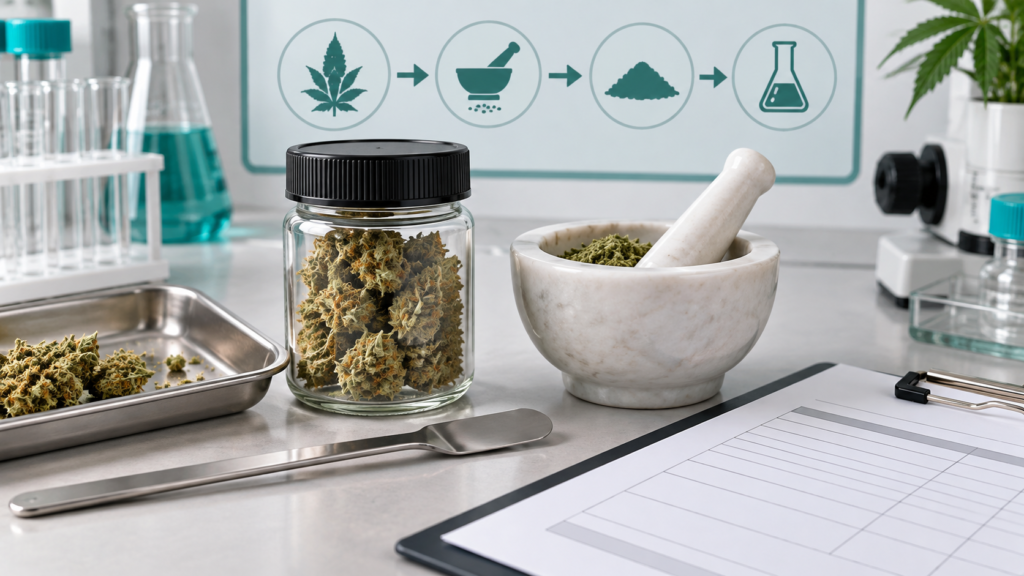
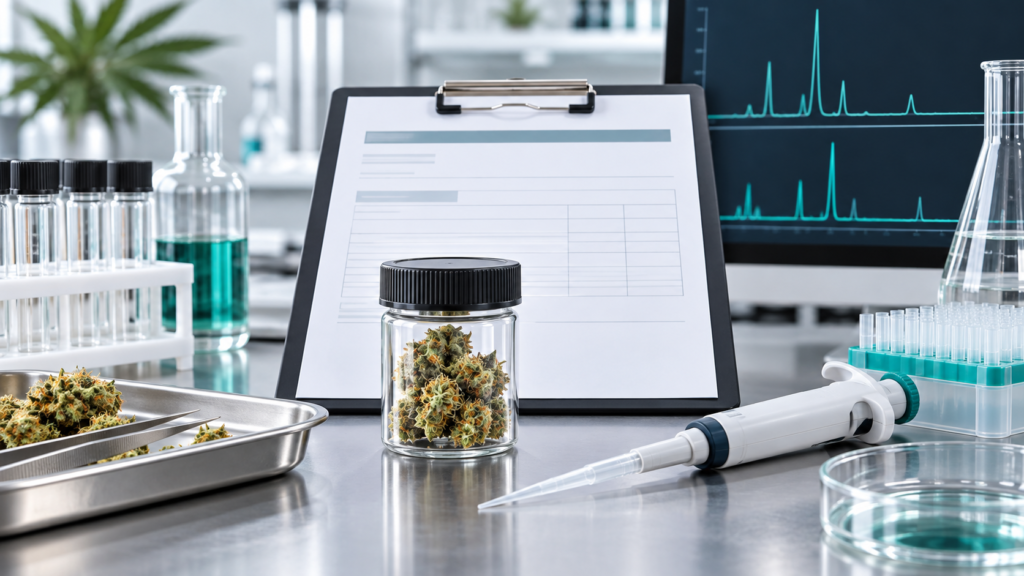
A pesticide panel is a stated set of laboratory analyses. It may be part of a broader COA that also contains cannabinoid, residual-solvent, microbial, heavy-metal, or other information. It is not a universal inventory of every substance that could ever be relevant. Read the report title, sample type, and panel heading before drawing conclusions from a table. A cannabis flower sample, gummy, vape oil, and finished beverage can be represented differently, so report identity matters.
Washington’s Liquor and Cannabis Board explains that consumers may request the certified laboratory name and quality-assurance test results for cannabis products in that state; it describes the COA as showing results for harmful contaminants and specific cannabinoids. That is a helpful consumer-rights example, but it is not a shortcut to assume that every state’s rules, panels, or access process are identical. Treat state pages as location-specific and ask the seller for the exact report relevant to the order.
Use this COA pesticide results checklist
- Match the product and batch. Confirm the product name, form, batch or lot code, and any sample identifier against the package or product page.
- Find the pesticide panel heading. Look for the title that tells you which analysis group you are reading. Do not assume another contaminant panel is a pesticide panel.
- Read the laboratory legend. Reports commonly define abbreviations, units, flags, and method notes near the table or in an appendix.
- Notice the reporting limit. A result can be reported relative to a laboratory’s stated threshold. The number and unit are part of the meaning.
- Check result qualifiers. Symbols, notes, or footnotes may identify a retest, dilution, method condition, or another reporting detail. Read them before interpreting the row.
- Compare only comparable reports. Two reports may use different analyte lists, matrices, reporting bases, or methods. Similar-looking tables are not automatically interchangeable.
- Ask a focused question if a field is missing. Request the current report, panel description, and explanation of any unmatched batch or undefined notation rather than accepting a broad “lab tested” statement.
Decode the terms without overclaiming
Analyte or compound name
Each row usually names the item the method is designed to measure. The list is specific to the panel. A report cannot establish a result for an item that is not included in its stated list. If you are comparing reports, place the analyte lists side by side rather than assuming a shorter list includes every name on a longer list.
Result and unit
The result is usually paired with a unit such as parts per million, parts per billion, micrograms per gram, or another laboratory-defined expression. Those units are not decorative. A number without its unit is incomplete and should not be used to rank products. Likewise, do not convert numbers casually across product forms; the report’s matrix and methodology affect what a comparison can support.
ND, not detected, or a similar entry
“ND” commonly means that the laboratory did not detect the named analyte under the stated method or reporting threshold. It does not mean the report has proven the total absence of every pesticide, every contaminant, or every possible risk. Read the legend, reporting limit, and test scope. If a report gives no definition, ask the laboratory or seller to identify the notation rather than rewriting it as a broad safety claim.
Pass, fail, or status field
Some reports include a status for a stated regulatory or quality-assurance program. A status does not make a product legal at a different destination, approved by the FDA, medically appropriate, or identical to every other batch. It describes the report’s own framework. The relevant rules and thresholds can change, so do not use an old screenshot as current regulatory advice.
Why the batch match comes before the pesticide numbers
A precise laboratory table is only as useful as its connection to the product. Before spending time on the rows, compare the batch or lot identifier, format, product description, and date context. The batch-matching checklist explains a practical order for that review, while the COA QR-code verification guide covers what to do when the report route is broken or generic.
If a product page says “tested” but the attached report is for a different flavor, potency, form, or lot, the link has not yet answered the buyer’s question. Keep a photo of the package identifier and the PDF or report URL. A clear question to customer support is better than trying to derive a batch match from a product family name.
What the FDA context adds
The FDA says that many questions about the safety and quality of CBD products remain unresolved. Its consumer information notes concerns about products that may contain inaccurate cannabinoid amounts and potential contaminants, including pesticides and heavy metals. This does not mean every item has the same issue, and it does not turn a general FDA page into a result for a particular package. It supports a careful evidence habit: read the current product documentation, avoid therapeutic claims, and do not turn a marketing label into a guarantee.
It also means that a pesticide COA is not a substitute for advice about medication interactions, pregnancy, breastfeeding, a medical condition, impairment, or a child or pet. The FDA strongly advises against CBD, THC, and marijuana during pregnancy or breastfeeding. For a personal health decision, use a qualified healthcare professional, not a laboratory table or product listing.
Make the COA part of a wider buying record
Save more than the table. Keep the product-page URL, the order or listing date, the package photo, the batch or lot code, and the direct PDF or report link together. That record lets you revisit a specific question without relying on memory if a listing changes. It is particularly useful when a report is replaced, a QR code later redirects, or a customer-support representative needs to identify which item you mean. Do not edit a screenshot or crop away the report header when asking for help; the header and sample details can be the facts that show whether the document relates to the correct batch.
Use the same record to separate a documentation question from a health or legal question. A buyer can ask, “Which current COA corresponds to lot ABC?” without asking the seller to make a medical promise. A seller can describe a document’s panel without deciding whether a product is appropriate for a person. For shipping, age, and regional availability, consult the current destination information separately. Keeping those questions separate makes each answer easier to verify and avoids giving a single test table more authority than it has.
When two reports look different
| Difference | Why it matters | Responsible response |
|---|---|---|
| Different product forms | A flower and a finished gummy are not necessarily tested or reported on the same basis. | Compare only the report tied to the exact form you are considering. |
| Different analyte lists | One panel may include names that the other does not. | Do not treat an omitted row as a matching result; request the scope. |
| Different units or limits | Values cannot be ranked reliably without the reporting context. | Read method notes or ask the laboratory/seller for an explanation. |
| Different batch codes | The documents may concern different samples. | Pause and seek the report for the exact product batch. |
Continue learning
- Herbxmind lab results
- How to read cannabis vape lab results
- What “lab tested” means on a cannabis vape label
- Browse product categories responsibly
Frequently asked questions
Does a cannabis COA with a pesticide section test for every possible contaminant?
No. A report only supports the analyses and sample described on it. Review the stated panel and ask the seller about anything the report does not show.
What does ND mean on a cannabis pesticide COA?
It commonly means not detected under the stated method or reporting threshold, but the precise meaning depends on the report’s legend, method, units, and reporting limit. Read those fields rather than treating ND as a universal claim.
Can I compare pesticide results from two different cannabis COAs?
Only with caution. The product form, batch, laboratory method, analyte list, units, and reporting limits may differ. Compare like with like and ask for clarification where the reports use different bases.
Bottom line
Reading cannabis pesticide test results on a COA starts with the exact product and batch, then moves to the named panel, result legend, units, limits, and qualifiers. The disciplined conclusion is often narrower than a product badge: this document reports these analyses for this identified sample. Reviewed August 15, 2026 against FDA consumer information and Washington State Liquor and Cannabis Board education. This is adult product-document education where permitted, not medical or legal advice and not a guarantee of safety, legality, test coverage, or delivery.
Sources: Washington State Liquor and Cannabis Board, Reading a Product Label; FDA consumer update on cannabis and cannabis-derived products.