

What Does Full-Spectrum CBD Mean? A Practical Label and COA Guide for U.S. Buyers
Short answer: “Full-spectrum CBD” usually means a hemp-derived product made to retain CBD together with other naturally occurring hemp compounds, which may include minor cannabinoids, terpenes, and a small amount of THC. The phrase is not a substitute for a complete ingredient list or a batch-specific certificate of analysis (COA). A careful buyer should confirm the product’s source, cannabinoid panel, THC result, serving information, ingredients, batch number, testing date, and destination rules before ordering.
That distinction matters because “full-spectrum” is a product description, not a universal testing standard. Two products can use the same phrase while differing in extraction method, cannabinoid profile, carrier oil, flavoring, serving size, and documentation. The most useful approach is to treat the label as a set of claims and the COA as evidence that should be matched to the exact product and batch. This guide explains how to do that without treating CBD as a medicine or assuming that a spectrum label guarantees a particular experience.
What does full-spectrum CBD mean in plain language?
In ordinary retail language, full-spectrum CBD refers to a hemp extract that has not been refined to remove every compound other than CBD. Depending on the plant material and manufacturing process, the extract may contain CBD as the main cannabinoid plus smaller amounts of other cannabinoids such as CBG or CBC, naturally occurring terpenes, and THC below the applicable legal threshold for a hemp product. The exact profile depends on the source material, extraction process, filtration, formulation, and testing method.
“Full-spectrum” does not mean “every compound in the plant is present in the same proportion.” It also does not mean that every product with the phrase contains the same amount of THC. One formula may show a measurable trace of THC, while another may show THC as not detected under the laboratory’s reporting limit. The result can depend on the crop, dilution, processing, test method, and the specific batch.
It is also important to separate marketing language from regulatory categories. U.S. rules can depend on the product type, intended use, ingredients, THC definition, state law, and the date of review. The FDA says cannabis-derived products remain subject to applicable federal authorities and that it has approved only a limited prescription CBD drug product for a specific medical use. That does not turn an over-the-counter full-spectrum product into an approved treatment. Consumers should not read “full-spectrum” as a promise to prevent, treat, cure, or diagnose a condition.
Full-spectrum CBD vs. broad-spectrum CBD vs. CBD isolate
These three terms are useful for comparing product design, but they still need to be checked against the actual label and COA.
Full-spectrum CBD
A full-spectrum formula is generally intended to preserve multiple naturally occurring hemp compounds. A COA may list CBD, minor cannabinoids, THC, and sometimes terpenes. The label may describe the product as an extract, whole-plant extract, or full-spectrum hemp extract. The presence and amount of THC should be verified rather than inferred from the phrase alone.
Broad-spectrum CBD
Broad-spectrum products are generally formulated to retain more than one hemp compound while removing or reducing THC. The important question is how the laboratory reports THC. “THC-free” can mean different things in everyday marketing, while a laboratory report may use “ND,” “not detected,” or a numerical result below a reporting limit. A buyer should review the method, limit of quantitation, and batch identity rather than relying only on a front-label phrase.
CBD isolate
CBD isolate is designed around CBD as a single primary cannabinoid. It may be appropriate for a buyer who wants a simpler cannabinoid profile, but the finished product still includes other ingredients such as a carrier oil, flavor, capsule material, sweetener, or topical base. Isolate does not automatically mean the product is higher quality, and full-spectrum does not automatically mean the product is more effective. These are formulation choices that should be evaluated against the buyer’s goals, sensitivities, and documentation requirements.
Why the label and COA must be read together
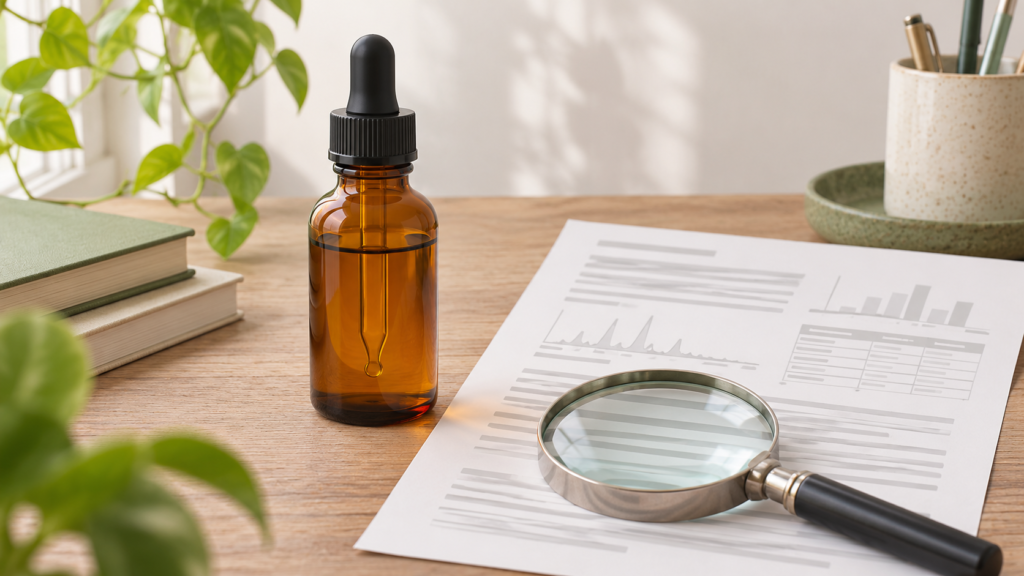
The label tells you what the seller is representing about the product. The COA shows what an identified laboratory reported for a specific sample. Neither document answers every question on its own. For example, a label may say “1,000 mg CBD,” but the buyer still needs to know whether that amount refers to the entire bottle, the total extract, or each serving. A COA may show a cannabinoid result, but it may not confirm the product’s flavor ingredients, allergen statement, packaging integrity, or shipping eligibility.
Reading the two documents together creates a simple evidence chain:
- The product page identifies the item and its intended format.
- The physical label identifies the ingredients, net contents, serving information, warnings, lot or batch number, and manufacturer details.
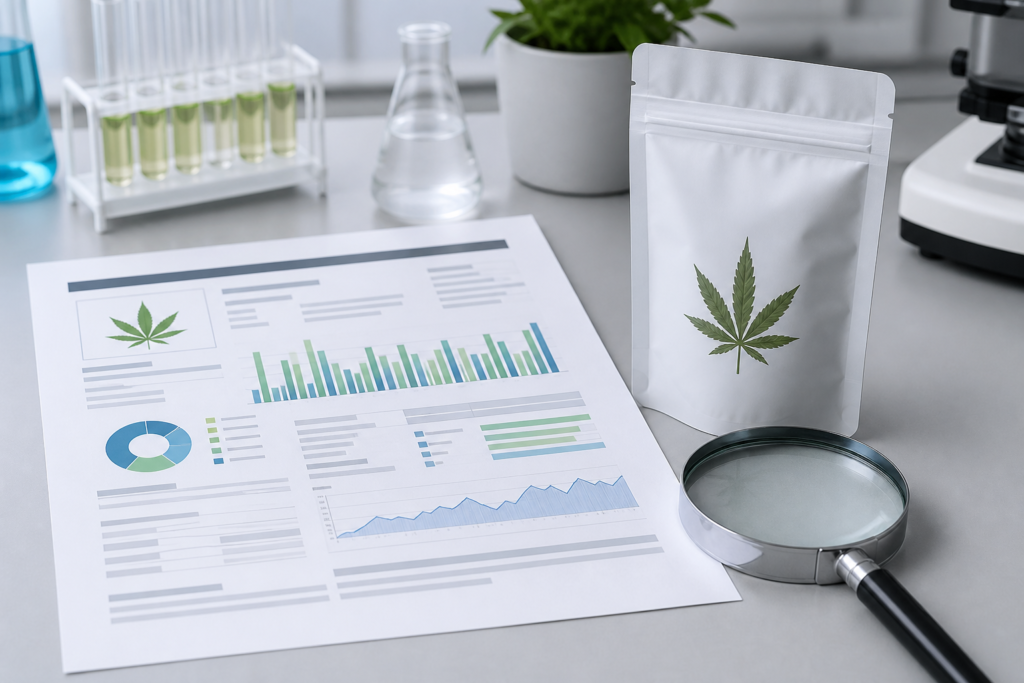
- The COA identifies the tested sample, laboratory, dates, method, cannabinoid findings, and any contaminant panels.
- The buyer checks whether the label, product page, and COA describe the same item and batch.
If the three sources conflict, pause before ordering. A mismatch is not proof that a product is unsafe or fraudulent, but it is a reason to ask the seller for clarification and current documentation. The goal is not to create a perfect laboratory investigation for every purchase. The goal is to avoid making a decision based on a vague spectrum claim alone.
Step 1: Start with the product identity
Before looking at cannabinoid numbers, identify exactly what you are comparing. Note the product name, format, size, flavor or variety, concentration, lot number, and the URL where the product is sold. A tincture, gummy, vape, flower item, capsule, and topical can all use CBD language while having different ingredient and use considerations.
For online shopping, save a screenshot or PDF of the product page at the time of review. Pages can change when a formula, package, or batch changes. Record the date you checked the information. If a product has multiple sizes or flavors, do not assume one COA covers every variation. Ask whether the document applies to the exact SKU, formula, and batch you would receive.
Look for the business name and a practical contact route. A transparent seller should be able to explain how the batch code on the package connects to the laboratory report. The seller does not need to disclose proprietary extraction details, but the response should be specific enough for a buyer to understand what was tested and when.
Step 2: Read the cannabinoid panel
The cannabinoid panel is usually the most important section for evaluating a full-spectrum claim. Look for the names and units used by the laboratory. Common entries can include CBD, CBDA, THC or delta-9 THC, THCA, CBG, CBGA, CBC, and other minor cannabinoids. Some reports list a total cannabinoid amount; others separate acidic and neutral forms. Do not add values yourself unless you understand the laboratory’s reporting conventions.
Compare the laboratory result with the label’s stated amount. A small difference can arise from sampling, measurement uncertainty, storage, or normal batch variation. A large unexplained difference deserves a question. Check whether the result is expressed as milligrams per gram, percentage by weight, milligrams per serving, or milligrams per container. A percentage is not the same thing as the amount in a bottle or edible piece.
For a liquid, ask how the total amount is calculated. If a bottle contains 30 milliliters and the label says 1,000 milligrams of CBD in the whole bottle, that is a different comparison from a label that says 1,000 milligrams of extract. If a gummy package contains 30 pieces, a total of 900 milligrams may mean about 30 milligrams per piece, but the buyer should confirm the serving definition and whether the number refers to CBD or total cannabinoids.
For a full-spectrum product, check whether the report actually lists a multi-cannabinoid profile. A label may use “full-spectrum” while the COA shows only CBD because the test panel was limited, the other compounds were below reporting limits, or the seller posted an incomplete document. That does not automatically invalidate the product, but it reduces what the document can prove.
Step 3: Understand the THC result without guessing
THC is the part of a full-spectrum discussion that deserves the most care. Hemp definitions and product rules can be based on THC concentration, total THC calculations, product type, and jurisdiction. A product can be described as hemp-derived while still requiring destination-specific review. Some buyers also need to avoid any detectable THC because of workplace testing, medication interactions, personal preference, or local rules.
Read the exact THC result and the laboratory’s reporting limit. “ND” means the substance was not detected above the method’s reporting limit; it does not necessarily mean the substance is chemically absent. If the report shows a numerical result, compare the unit and calculation basis with the relevant product requirement. For THCA, ask whether the report or label explains how total THC is calculated. Do not use a general internet percentage as a substitute for a current product-specific assessment.
When buying online, review the seller’s shipping and legal-awareness pages as well as the product disclaimer. A retailer may restrict certain products or destinations even when the product is marketed as hemp-derived. Rules can change, and a statement written for one state or one date should not be treated as a universal conclusion. The safest buyer workflow is to verify the product, destination, age requirement, and current seller policy close to the order date.
Step 4: Read the ingredient list beyond CBD
A full-spectrum label describes the extract, not the entire finished product. A tincture may include MCT oil, hemp seed oil, natural flavors, botanical extracts, or sweeteners. A gummy may contain sugar, pectin or gelatin, acids, flavorings, colors, and processing aids. A vape formula may include a carrier, terpenes, and hardware-specific information. A topical may include waxes, moisturizers, fragrance, or preservatives.
Make a short list of ingredients you want, ingredients you avoid, and questions that require a seller response. This is especially important if you have allergies, follow a restricted diet, avoid animal-derived gelatin, or are sensitive to flavors and fragrances. A COA cannot replace the finished-product ingredient list. A contaminant panel also does not prove that every ingredient is suitable for every person.
Be cautious with language such as “natural,” “clean,” “premium,” or “plant-based” when it appears without definitions. Those words may describe a marketing position rather than a measurable specification. Ask whether the carrier oil, flavor, and added botanicals are identified by name. If the product contains a blend, the buyer should be able to understand the blend’s role without being pushed toward medical conclusions.
Step 5: Check the contaminant and quality panels
A stronger COA may include panels for pesticides, heavy metals, residual solvents, microbes, mycotoxins, and foreign material. The exact panel depends on the product type and laboratory scope. A report showing “pass” is useful only when the panel, method, sample identity, and acceptance criteria are visible enough to interpret. If the report displays only a green badge with no details, it provides less evidence than a report with named analytes and units.
Look for a laboratory name, accreditation or quality information, report date, sample received date, sample description, and authorization or approval fields where applicable. Do not assume that a logo on a PDF proves current accreditation. If the laboratory is important to your decision, verify the laboratory through an official source or ask the seller for the relevant scope. The purpose is not to accuse a brand; it is to confirm that the report is traceable and fit for the product claim.
Testing is a snapshot, not a permanent guarantee. It does not show what happens after the product is stored in heat, light, or an opened package. It also does not prove that every unit in a large production run has identical results. Good storage, lot tracking, and a clear replacement process are part of responsible product handling.
Step 6: Match the COA to the batch
Batch matching is the most practical way to improve confidence. Find the lot or batch code on the package and locate the same code on the COA. If the COA uses a sample name that is not the same as the retail name, ask the seller to explain the connection. Check the product size and flavor as well. A report for an unflavored bulk extract may not represent a flavored finished gummy or a cartridge formula.
Check dates too. The report date should be reasonably related to the current product inventory, although a business may continue selling a properly stored batch for some time. If the document is several years old or the lot code is missing, ask for a current report. A new document is not automatically better, but a current and traceable document is more relevant to a current purchase.
If the seller says a single COA covers all products, ask whether the formulas share the same extract and whether the finished products add ingredients that require separate testing. It is reasonable for a brand to use a common bulk-extract report in some situations, but the business should explain what the document does and does not cover.
What “full-spectrum” does not tell you
The phrase alone does not tell you whether the product is right for your situation. It does not tell you the flavor, serving size, package durability, shipping eligibility, age requirement, return policy, or customer-support quality. It does not prove that the product will deliver a particular feeling or result. It does not replace advice from a qualified healthcare professional when medications, pregnancy, breastfeeding, liver concerns, or other health factors are involved.
The CDC notes that CBD is not impairing, but also states that CBD products are not risk-free and that scientists are still learning how CBD affects the body. The FDA warns that CBD can involve safety considerations, including possible interactions and liver-related concerns identified in its review of an approved prescription product. These statements are evidence boundaries, not reasons to panic. They are reminders to keep consumer education separate from treatment claims.
Do not buy a full-spectrum product because a seller implies it can diagnose a problem, replace prescribed care, or guarantee an outcome. Avoid testimonials framed as medical proof. A compliant educational page can explain ingredients, documentation, storage, and responsible buying without promising that CBD will treat or cure a condition.
A practical full-spectrum CBD buying checklist
- Is the exact product format and size clear?
- Does the label identify the amount of CBD per serving and per package?
- Does the label identify other cannabinoids or explain that the profile may vary?
- Is the THC result visible on a product-specific COA?
- Does the COA show a batch or lot number that matches the package?
- Are the laboratory name, dates, methods, and units visible?
- Are relevant contaminant panels included for the product format?
- Does the ingredient list identify the carrier, flavor, sweetener, or capsule materials?
- Is the seller’s contact information and business identity easy to find?
- Does the shipping page explain destination restrictions and policy changes?
- Is the return policy clear before you pay?
- Does the page avoid treatment, cure, diagnosis, and guaranteed-result claims?
If the answer to several questions is no, choose a product with clearer documentation or contact the seller before ordering. A lower price does not compensate for a product identity that cannot be verified. For buyers comparing several formulas, place the information in a simple table with columns for total CBD, CBD per serving, THC result, batch match, ingredient differences, test date, shipping notes, and return terms.
Questions to ask the seller
Good questions are specific and easy to answer. You can ask: “Does this COA apply to the exact lot currently shipping?” “Is the stated CBD amount per serving or per package?” “What is the laboratory’s THC reporting limit?” “Does the report cover the finished product or only the bulk extract?” “Which ingredients are added after extraction?” “What storage conditions do you recommend?” “Which destinations are excluded under your current shipping policy?”
A clear answer should identify the document or page that supports it. A vague answer does not prove wrongdoing, but it tells you that the product may not be a good fit for a buyer who needs strong documentation. Keep copies of the answer and the page you reviewed. This helps you compare products consistently and gives customer service a concrete reference if the package differs from the listing.
Frequently asked questions
Does full-spectrum CBD contain THC?
It may contain THC, often in a small amount, but the exact result depends on the formula and batch. Check the current COA instead of assuming that every full-spectrum product has the same THC level. “Not detected” also depends on the laboratory’s reporting limit.
Is full-spectrum CBD stronger than CBD isolate?
Not automatically. Full-spectrum and isolate describe different formulation approaches. A buyer should compare the actual CBD amount, serving size, ingredient list, cannabinoid panel, and documentation rather than using “stronger” as a shortcut.
Is broad-spectrum CBD completely THC-free?
Many broad-spectrum products are designed to remove or reduce THC, but the label phrase alone does not establish a laboratory result. Review the batch COA and the THC reporting limit. If avoiding THC is important, ask the seller how the result was measured.
Can a COA prove that a CBD product is safe for me?
No. A COA can provide evidence about tested compounds and panels, but it does not evaluate your health history, medications, allergies, or personal risk. Use the report as a product-quality document, not as medical clearance.
How often should I check a CBD COA?
Check the COA whenever you buy a different product, size, flavor, or batch. Also review it when a formula, manufacturer, package, or seller changes. A saved report from an older batch may not represent current inventory.
Editorial note and evidence boundaries
This article is consumer education, not medical or legal advice. It explains common retail usage of spectrum terms and a practical document-review method. It does not certify any brand, laboratory, product, or legal status. Product rules can differ by state, product category, intended use, and date. The FDA’s consumer and regulatory pages, the CDC’s CBD information, and USDA hemp-program materials are higher-priority sources for broad federal and public-health context; a seller’s page is a secondary source for its own product claims.
Source review for this article was completed on November 13, 2026, using the FDA cannabis and CBD regulatory information, the FDA consumer update on cannabis-derived compounds, the CDC’s About CBD page, and USDA hemp-production program information. Government guidance can change. Buyers should review current official pages and destination-specific rules before making a purchase.
For related buying education, review Herbxmind’s CBD products collection, lab results information, where we ship guidance, and legal disclaimer. If a product question is not answered by the label or COA, use the contact page before ordering.
Conclusion
Full-spectrum CBD is best understood as a formulation description: an extract intended to retain CBD alongside other hemp compounds, potentially including trace THC. The phrase can help you compare products, but it cannot replace evidence. Start with the exact product identity, read the cannabinoid panel, verify the THC result, review the finished-product ingredients, inspect contaminant testing, and match the COA to the lot or batch. Then check shipping, return, and destination information before paying.
When a product page makes a clear claim and the label and batch documentation support it, you can make a more informed comparison. When the documents conflict or the seller cannot explain the connection, pause and choose a product with better traceability. That habit keeps the buying decision grounded in what can actually be verified, without turning a spectrum label into a promise of medical benefit.