

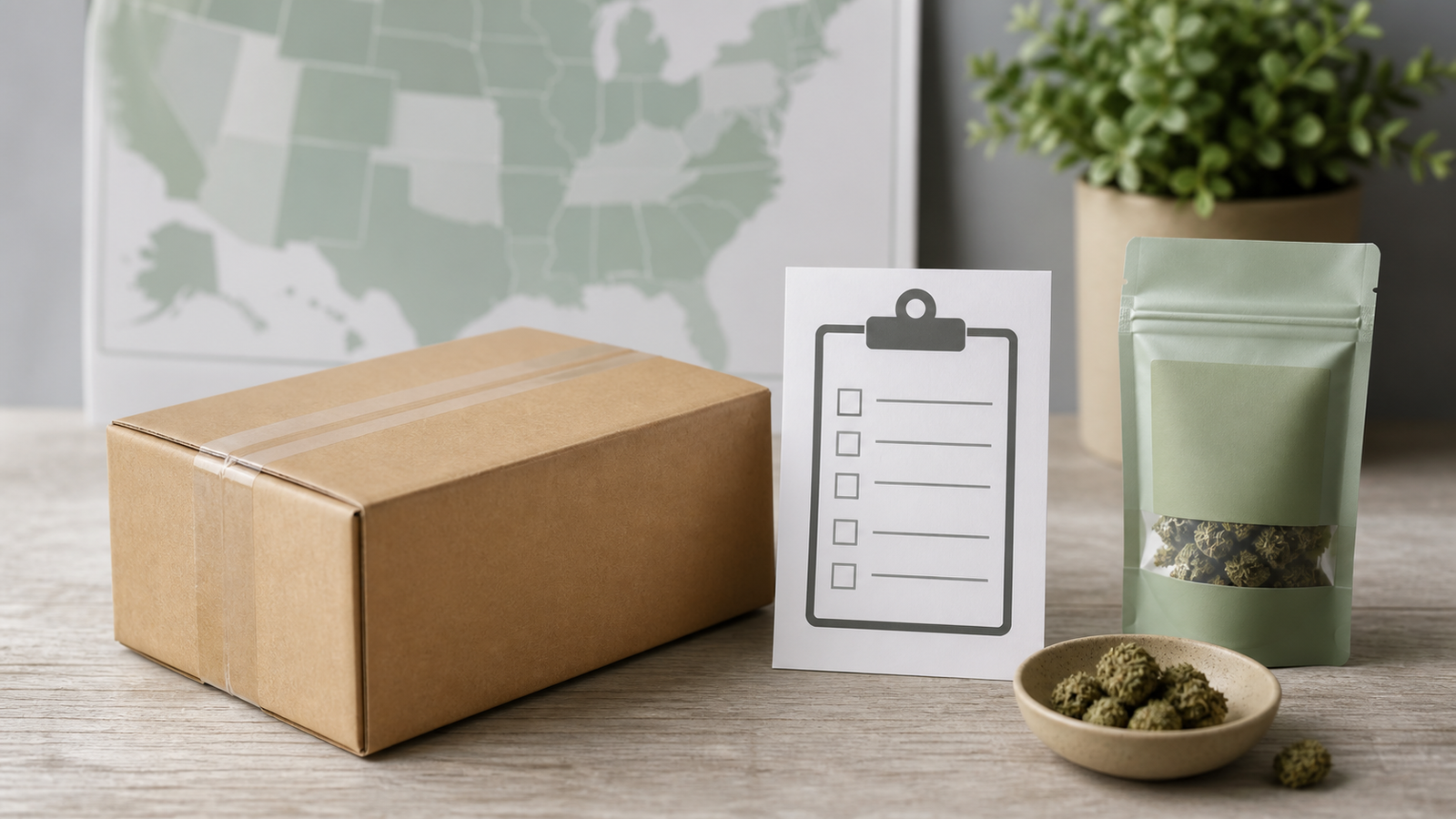
Quick answer: A cannabis shipping checklist should confirm the exact product, destination eligibility, current seller policy, carrier restrictions, age or signature requirements, package tracking, return steps, and batch information. “Ships nationwide” is not a complete legal or logistics answer. Verify the current rules for the product and destination before ordering.
Adults searching for a cannabis shipping checklist often want to know whether a vape, flower, gummy, tincture, or hemp-derived THC product can reach a particular address. Shipping depends on product composition, destination, carrier, seller policy, age rules, and changing regulations. This guide focuses on practical records and questions, not a universal legal conclusion.
Before checkout
- Identify the exact product format and cannabinoid profile.
- Read the seller’s current shipping policy.
- Check the destination eligibility page.
- Review age verification and adult-signature requirements.
- Confirm the carrier and tracking process.
- Read return and damaged-order instructions.
- Record the product page, batch information, and order terms.
Start with shipping policy and regional availability. The seller’s page is useful, but it is not a substitute for current official federal, state, or local information.
Why product identity matters
CBD, hemp flower, hemp-derived THC, delta-9, vapes, edibles, and accessories may have different handling and shipping considerations. A seller can exclude one format while accepting another. Read the ingredients, THC information, net contents, and batch report before assuming that all products in a store have the same eligibility.
Use the delta-8 and delta-9 label guide, hemp seed oil comparison, and CBD label checklist to identify what you are actually ordering.
Age, address, and delivery checks
A seller may verify age at checkout, use an identity service, require an adult signature, or restrict delivery to a physical address. Review the age-verification guide. Use accurate billing and shipping information, and do not ask a minor or neighbor to receive an age-restricted order.
Check whether the product can be delivered to an apartment, office, mailbox, hotel, or shared address. Follow the carrier’s current instructions. A previous successful delivery does not prove that a later product or destination has the same conditions.
What to do when a package arrives
Photograph the shipping box, carrier label, seal, and product. Check the product name, batch code, package condition, and expected quantity. If the package is crushed, leaking, tampered with, or wrong, preserve the packaging and contact the seller before opening or using it. Read the return-policy guide.
Keep cannabinoid products in original labeled packaging and away from children and pets. Do not transfer a product into an unmarked container or repair a damaged vape device.
Official information and evidence boundaries
The FDA explains that cannabis-derived products are subject to a changing regulatory framework and that many CBD products have not been evaluated as general medicines. Read the FDA regulation overview. The CDC provides public-health information in its FAQ.
Do not describe a shipping policy as proof that a product is legal everywhere. Do not make medical claims or guarantee a result. Verify current official information where the product will be received.
Cannabis shipping checklist
- Exact product and cannabinoid identity confirmed?
- Destination listed as eligible?
- Current seller policy reviewed?
- Carrier and tracking clear?
- Age or adult-signature rules understood?
- Return steps saved?
- Batch and product records retained?
- Package condition photographed?
- Current official sources checked?
How to handle a shipping-policy conflict
If the product page says one thing and the shipping page says another, save both pages and ask support which policy applies to the exact product and destination. Do not choose the statement that is most convenient. A product may be available in one state but excluded in another, or a seller may use different carrier methods for different formats.
If checkout accepts the address, that is not necessarily a final eligibility determination. An order can still be held for age review, payment review, inventory, carrier limits, or a destination rule. Use accurate billing and shipping information and do not create duplicate accounts to bypass a review.
Recordkeeping for a delivered order
Save the order confirmation, tracking number, product page, shipping policy, batch code, label photograph, and COA. When the package arrives, photograph the outside, seal, product, and packing slip. Check the product name, quantity, batch, and package condition before opening it.
If the parcel is damaged or wrong, keep the box and contact the seller through the official route. The return checklist explains evidence and authorization. Do not transfer the product to an unmarked container or discard the packaging before support responds.
Current rules and responsible language
Shipping guidance can change with product composition, state rules, carrier practices, and official enforcement. Use current government sources for legal questions. Do not describe a seller’s shipping page as proof that a product is legal nationwide, and do not promise that any delivery method is available everywhere.
Review the product label, COA, and policies together. The COA guide can help with traceability, but a report does not determine destination eligibility. The age guide explains why adult verification is only one part of the transaction.
Questions to ask before ordering
- Which exact products can reach my destination?
- What carrier and signature rules apply?
- What happens if the order is delayed or refused?
- How is a damaged package handled?
- Which product and batch records should I keep?
- Where can I find the current policy date?
Write down the answer and the date. Recheck the same information when placing a later order because a previous delivery does not guarantee identical conditions.
Use a simple shipping record with the exact product, destination, date, policy URL, order number, carrier, and batch code. If the seller changes a policy or the product changes format, create a new record. Do not overwrite old information that may explain a past order.
A delivery confirmation is not a universal legal conclusion. It shows that one transaction moved through the seller and carrier process. It does not establish that every product can be shipped to every address, or that a future order will be treated the same way.
If a package is delayed, refused, or returned, ask support which rule or process applies. Keep tracking records and follow the seller’s return instructions. Do not ask a minor to accept a package, falsify an address, or create a duplicate account to bypass review.
Responsible shipping education is about verification and records. It helps shoppers ask better questions without pretending that a general article can replace current official guidance for a specific destination.
Check the product page again immediately before payment, especially when the seller lists state exclusions or product-specific limits. Keep the policy date and destination with the order record.
If an official source and seller page disagree, pause the order and ask which current requirement controls. Do not rely on a search snippet or old social-media post.
Keep package records until the return, refund, or support question is closed. A batch code and product photograph can be more useful than a general order description. Do not treat a successful delivery as permission to repeat a shipment under different conditions.
When a policy is unclear, ask for the current written rule for the exact product and destination. Save the answer with the order. Do not rely on a search snippet, old social post, or broad phrase such as “ships nationwide.”
Record the date of the answer because policies can change.
Keep the product page, policy, and tracking details together. If the parcel is delayed or refused, contact the seller using the official support route and ask which current procedure applies. Do not falsify an address, create a duplicate account, or ask a minor to receive the package. A careful record helps distinguish a carrier issue from a destination restriction, age review, damaged shipment, or product-specific eligibility question. The package label and batch code can also help support identify the exact item without relying on memory.
That simple record supports a safer, more accurate shipping conversation.
Before ordering, confirm the exact destination and the exact product rather than relying on a previous transaction. Keep the current policy URL and date with the record. If the seller cannot explain an exclusion, pause and consult the relevant official source.
That makes later support questions more precise.
Keep the policy date with the delivery record.
Frequently asked questions
Can cannabis products ship to every state?
Do not assume so. Eligibility can depend on product, destination, carrier, and current rules.
Is a shipping policy legal advice?
No. It is a seller process document. Check current official guidance.
What if the carrier loses the package?
Use the seller’s tracking and support process, and keep your order evidence.
Can I travel with a shipped product?
Do not infer travel permission from a shipping confirmation. Check current destination and transportation rules.
Conclusion
A cannabis shipping checklist reduces avoidable confusion: identify the product, verify the destination, read current policies, understand age and delivery checks, preserve package evidence, and consult official sources. Treat “ships nationwide” as a prompt for further verification, not as a universal conclusion.
Editorial note: Herbxmind publishes adult-use consumer education. This article is not legal, medical, or shipping advice; rules, carriers, and product policies can change.