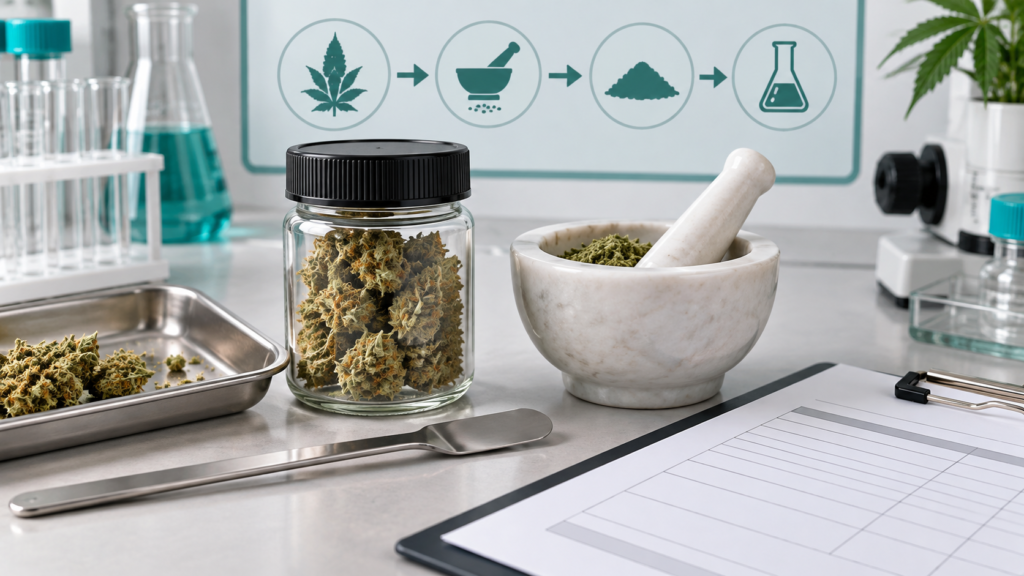


Quick answer: Cannabis COA sample preparation describes how a submitted product sample was handled before analysis, such as homogenizing flower, mixing a formulation, or preparing an extract. The preparation matters because the method and reported units depend on the product type. Read it with the sample identity, units, limits, qualifiers, and batch code.
When a product page says “lab tested,” the phrase is only a starting point. It does not, by itself, identify the reported analytes, units, method, or tested batch. This guide explains how to read a cannabis COA sample preparation without treating a certificate or logo as proof of every product claim.
What a sample preparation means on a cannabis COA
How analytical preparation changes the evidence record
How dilution notes relate to a cannabis COA cannabinoid profile
How to read a cannabis COA sample preparation
- Find the dilution note, method name, and laboratory identity.
- Check whether the method applies to the product preparation tested.
- Read units, reporting limits, qualifiers, dilution notes, and any mathematical adjustment.
- Match the report to the finished product and batch code.
- Ask the seller when a method abbreviation or preparation is unexplained.
Methods are not interchangeable just because two reports use the same analyte name. The COA cannabinoid profile guide, potency-units guide, and lab accreditation guide provide related context.
- Confirm the report identifies the finished product and batch.
- List each cannabinoid reported, including CBD, THC, and minor cannabinoids.
- Record the unit and basis: percent, mg/g, mg/mL, or serving.
- Read qualifiers, detection limits, and method notes.
- Compare the report with the package only after matching units.
Use the COA potency-units guide, COA reading guide, and COA QR-code guide. A profile describes the submitted sample and does not guarantee every future batch.
Find the analyte, unit, method, and reporting limit together. A result may be shown as ND, below limit, or a numeric value. Those terms need the report’s own definitions. Record the exact wording instead of translating every non-numeric result into “none detected.”
- Identify the analyte and unit.
- Locate the detection or reporting limit.
- Read footnotes about dilution, preparation, or qualifiers.
- Match the report to the finished product and batch.
- Ask the seller when an abbreviation is undefined.
Use the COA reading guide, pesticide-result guide, and sample-date guide for related checks.
A sample preparation is a traceability detail, not a quality guarantee. It describes the material submitted for analysis and helps a reader ask whether the method fits the finished product. The useful question is not simply whether a lab is “accredited,” but whether the reported method and preparation make sense for the cannabinoid, contaminant, or product-format question being evaluated.
Look for the laboratory’s legal name, address, accreditation body, certificate number, preparation document, and current validity. If a report shows only a lab name and a decorative badge, treat the credential as unverified until you can find the issuing body’s own directory or certificate record.
What to check on a laboratory report
- Record the lab’s exact legal name rather than relying on a shortened brand name.
- Find the report number, issue date, sample date, and product description.
- Match the batch or lot code to the package you are evaluating.
- Check whether the result is for a finished gummy, oil, vape, flower, or raw extract.
- Review the reported units, dilution notes, reporting limits, and any qualifiers.
- Compare the listed analytes with the claims made on the product page.
A report can be authentic and still be a poor match for the product in front of you. For example, a raw-material report may not establish the composition of a finished product after flavoring, carrier oil, heating, or formulation. Use the COA reading guide and the batch-matching checklist together.
How to verify sample preparations without overclaiming
Start with the accreditor named on the certificate. Search the accreditor’s official public directory for the laboratory’s legal name and compare the certificate number and preparation. Do not treat a search result, social-media post, or seller screenshot as the final record. Save the official certificate or preparation page with the report date for your notes.
Next, compare the preparation with the test panel. If the report lists cannabinoids but the preparation you found covers only environmental chemistry, ask the seller for clarification. If no public verification is available, record that limitation. “Could not verify” is more accurate than “fake,” while “accredited” should not be used as a substitute for reviewing the result itself.
Accreditation is not the same as a product guarantee
A laboratory credential concerns the laboratory’s assessed capability within a defined preparation. It does not guarantee that a seller submitted every batch, that the sample was collected correctly, or that the product remained unchanged after testing. It also does not establish that a cannabinoid product will produce a particular result for every adult.
The FDA explains that many cannabis-derived retail products raise safety, quality, labeling, and regulatory questions. Read the FDA approval facts and its consumer update. The CDC also provides public-health context in its cannabis FAQ.
Questions to ask a CBD seller
- What is the laboratory’s full legal name?
- Which accreditation body issued the credential?
- What is the active preparation and expiration date?
- Does the preparation include this product preparation and method?
- Does the report match the finished product and batch?
- How are updated reports posted when the formula changes?
- Which results are below a reporting limit rather than confirmed absent?
A transparent seller should answer these questions with current documents and clear language. If the response relies on a badge, vague “premium testing” phrase, or an unrelated report, pause the purchase and compare another product. Read the brand-website evaluation guide for additional trust checks.
How to build a buyer’s report-analytical preparation record
Create one note for each product. Write the product name, form, net contents, batch code, report number, lab name, report date, test panels, cannabinoid units, and the exact URL where the report was found. Add a screenshot of the package and note the date you checked the accreditation directory. This makes it easier to spot a changed formula or reused PDF.
Separate three kinds of evidence: the seller’s claim, the laboratory’s report, and the accreditor’s credential. They answer different questions. The seller describes what it offers; the report describes the submitted sample; the accreditor record describes the laboratory’s assessed preparation. Keeping them separate reduces the chance that one strong-looking document will silently support a broader claim.
FAQ
Is an accredited lab always required?
Requirements depend on the product, jurisdiction, contract, and applicable rules. This article does not make a universal legal determination. Accreditation is a useful credibility signal, but buyers should review the actual preparation and batch evidence.
Does a COA prove a CBD product is safe?
No. A COA is a report about a submitted sample and listed methods. It does not replace professional advice or prove a universal safety outcome.
What if I cannot verify the certificate?
Record the uncertainty, ask the seller for the official preparation document, and consider pausing until the evidence is clear.
Conclusion
Use a COA sample preparation as a traceability detail, not a shortcut. Confirm the legal lab identity, accreditor, active preparation, method, finished-product match, batch code, units, limits, and current report. Choose information that can be checked and explained, and revisit it when the product or rules change.
Editorial note: Herbxmind publishes adult-use consumer education. This article is not medical or legal advice. Laboratory credentials, product formulas, reports, and regulations can change.
A closer look at laboratory preparation
Preparation language can look technical, but the practical task is straightforward: connect the laboratory’s approved capability to the product and question you are evaluating. A cannabinoid panel, a contaminant panel, and a stability or identity method are not interchangeable. If the preparation lists a method code, preparation, or analyte group, copy that information into your record and compare it with the report.
Pay attention to the difference between a laboratory that performed an analysis and a company that merely hosts or formats a PDF. The report should identify the testing laboratory and the sample. A seller may use a fulfillment partner, a manufacturer, or a separate laboratory; that arrangement is not automatically a problem, but it should be disclosed clearly enough for a buyer to follow the evidence.
Check the report’s version history when available. A corrected report should explain what changed. A replacement PDF with a new date but no explanation deserves a question. These checks do not prove wrongdoing; they help you distinguish a current document from a file that has been reused without context.
Review whether the report shows qualitative findings, quantitative results, or both. A “pass” label can be less informative than the actual result, unit, and reporting limit. A result below a limit is not the same wording as zero in every analytical context. Record exactly what the report says and avoid translating a laboratory qualifier into a stronger marketing statement.
When a product contains several cannabinoids, confirm that the report identifies each relevant compound separately. Do not infer a missing cannabinoid from the product name. Likewise, do not infer a contaminant result from a panel that was not listed. A complete review is allowed to end with an unknown field.
For repeat purchases, perform the check again. A familiar product name, package color, or seller URL does not prove that the batch, formula, laboratory, or report is unchanged. The date of verification belongs in your record because a credential or preparation may later be renewed, modified, suspended, or replaced.
These steps create a defensible consumer record without pretending to conduct laboratory science. They also give customer support a specific question to answer. Instead of asking whether a brand is “legitimate,” ask whether the attached report matches the finished product, whether the lab’s preparation covers the method, and where the active accreditation record can be found.
Keep the language precise in your own notes. “Report located” means you found a document. “Batch matched” means its code and product description agree with the package. “Accreditation verified” means the issuing body’s record supports the stated laboratory and preparation. Those are separate checkpoints, and separating them prevents a single document from carrying more weight than it deserves.
If a seller cannot answer a basic traceability question, that is useful information for the purchase decision. You can request clarification, choose another product, or wait. A careful buyer does not need to accuse anyone or make a scientific judgment beyond the available evidence.
Before relying on a report, check that the document is readable, dated, and connected to a specific sample. A generic report without a batch or product description has limited value for a finished item. Save the original link and note any missing field so your conclusion remains proportional to the evidence.
A careful record is useful even when the answer is simply “not enough information.” That conclusion protects against overconfidence and gives the seller a precise opportunity to improve its documentation.
Detection limits can differ between analytes and methods, so comparing two reports by the word “pass” alone can hide important differences. Keep the report version, sample identity, unit, qualifier, and limit in separate fields. A transparent review is allowed to end with an unknown field.