

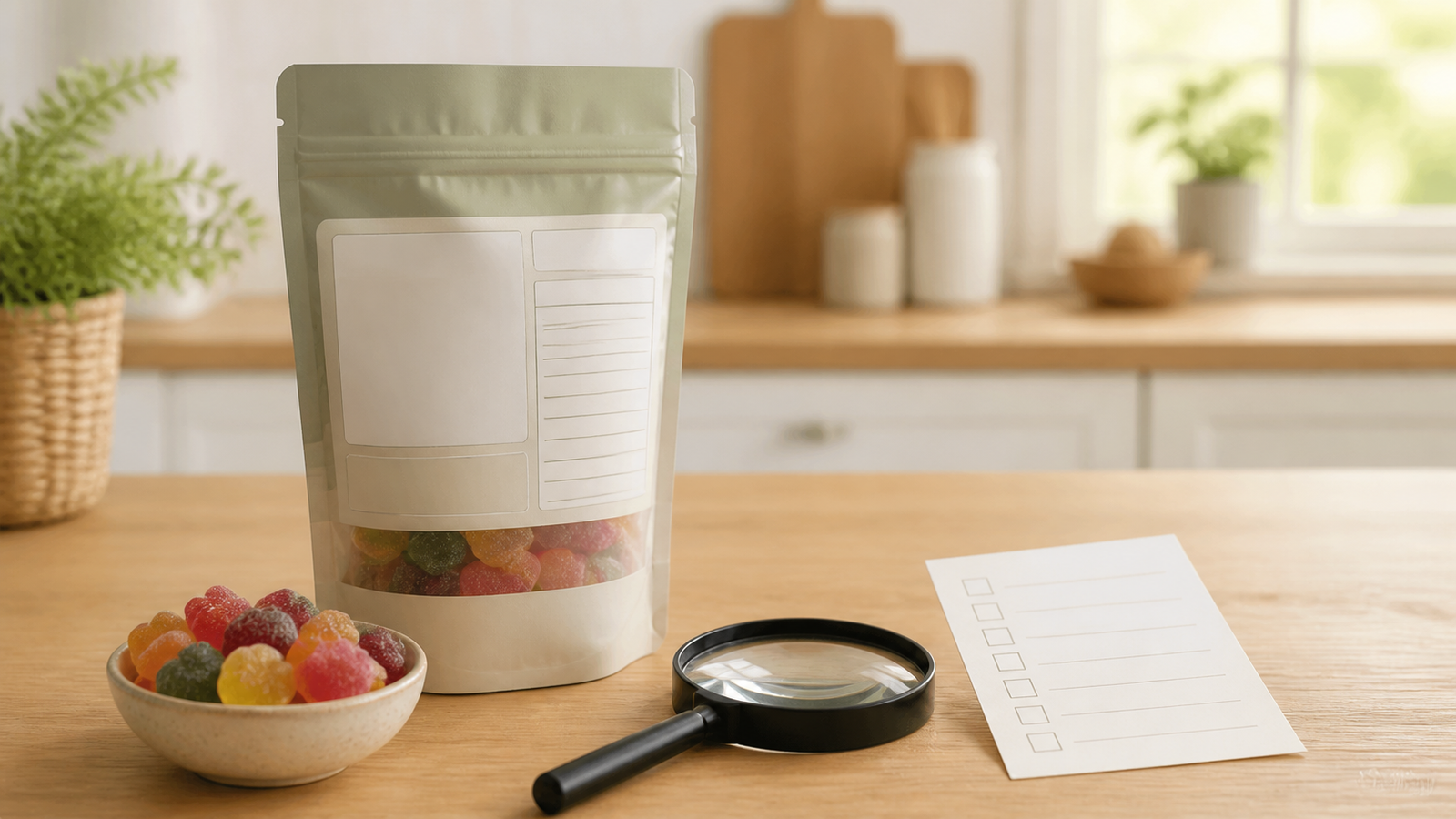
Quick answer: A CBD gummy ingredient list is most useful when you read it alongside the package’s cannabinoid statement, serving information, allergen wording, lot or batch identifier, and storage directions. Start with the actual retail package, not a marketing image. Identify the base ingredients, sweeteners, gelling agent, flavor and color wording, and any clearly stated allergen information. Then compare the package details with the product page and, where provided, a batch-linked COA. If a label is incomplete, hard to read, or does not answer an allergy-related question, pause and ask the seller or manufacturer before buying or using it.
This is an adult buying-education guide, not medical advice, a nutrition assessment, or a promise that a product is lawful, safe, approved, or right for any individual. Federal and state treatment of cannabinoid products can differ and change. FDA food-label resources are used here to explain familiar label-reading habits; they do not mean that every cannabinoid gummy is regulated as a conventional FDA food or that FDA has evaluated a particular CBD product.
Use this CBD gummy ingredient list checklist first
- Read the package in hand. Confirm that the product name, package size, and stated cannabinoid format match the listing you intended to buy.
- Find the ingredient statement. Read it from beginning to end rather than searching only for one familiar word.
- Separate base ingredients from active-product information. Sugar, syrup, pectin, gelatin, acids, oils, flavors, colors, and coatings do not answer the same question as a stated CBD amount.
- Look for allergen information. Read both the ingredient list and any statement beginning with “Contains.” Treat advisory wording such as “may contain” as a different type of information.
- Check the serving panel. Compare the stated amount per piece, number of pieces per serving, servings per package, and total package amount. The serving-size label-math guide shows a practical way to keep those units separate.
- Record the lot or batch detail. A batch code can help connect the physical package with a product-specific document or a support request.
- Ask a focused question when the label leaves uncertainty. Do not guess whether an unnamed ingredient, processing aid, or advisory phrase resolves an allergy, dietary, legal, or health question.
What an ingredient list can—and cannot—tell you
An ingredient list is a disclosure tool, not a quality score. It can help an adult shopper see what the manufacturer identifies as ingredients in that package. It does not independently verify a formula, prove a product was tested for every possible concern, establish medical suitability, or guarantee an individual’s experience. Keep that boundary clear when comparing gummies with different flavors, textures, or packaging claims.
For FDA-regulated packaged foods, ingredient names generally appear in descending order of predominance by weight. The FDA also explains that some ingredients can be identified collectively, such as flavors or spices, while certified colors must be named. That general reading convention is useful context for a gummy package, but it is not permission to infer a precise recipe, cannabinoid concentration, or allergen status from position alone. Product category, jurisdiction, and the actual label matter.
A simple way to read the list is to group what you see. First, identify the gummy base: sugars or syrups, water, starches, pectin, gelatin, or other texture-building ingredients. Second, note flavor, acid, color, or coating ingredients. Third, locate any oil, extract, or cannabinoid wording exactly as printed. Finally, step back and compare the list with the package warnings and serving information. This four-part pass is easier to repeat than trying to decide whether a long list is “good” or “bad” at a glance.
Gelatin, pectin, sweeteners, flavors, and colors: read the words, not the vibe
Many gummies use gelatin or pectin to create texture, but a shopper should not assume that one word settles every dietary question. A package may use other supporting ingredients, coatings, or sub-ingredients. If a dietary preference, religious requirement, allergy, or sensitivity is important, rely on the full package disclosure and the manufacturer’s current answer—not an assumed meaning of “gummy,” a color, or a product photograph.
Sweeteners and acids affect taste and texture. Flavor and color language describes components of the confection, not whether the cannabinoid information is accurate. If the label lists a general term such as “natural flavors,” do not invent the individual substances behind that term. The practical next step is a seller or manufacturer question: “Can you provide the current ingredient and allergen information for this exact package or lot?” Save the reply with the package details if the answer informs a purchase decision.
Likewise, a familiar ingredient does not make a product comparable to another gummy. Package weight, serving size, number of pieces, and stated cannabinoid amount can all differ. Start product comparison with the format and units explained in Herbxmind’s CBD gummies label guide, then return to the ingredient statement for the specific product.
How to read allergen information without over-reading it
FDA identifies nine major food allergens in U.S. labeling law: milk, egg, fish, crustacean shellfish, tree nuts, peanuts, wheat, soybeans, and sesame. On applicable packaged food labels, an allergen source can appear in the ingredient list or in a Contains statement immediately after or next to that list. The FDA also distinguishes voluntary advisory wording—such as “may contain”—from a required allergen declaration. Advisory language should be read as its own statement, not as proof that every possible exposure scenario has been ruled in or out.
For a CBD gummy, first check whether the package makes a clear ingredient or allergen declaration. Next, check whether that information appears to apply to the exact flavor and package in your hand. A multipack, limited edition, or reformulated product can differ from an older web listing. If you cannot read the label, have an allergy-related concern, or notice a mismatch, do not try to solve it through online comments. Contact the named manufacturer or seller, identify the product and lot, and seek appropriate professional guidance for personal health decisions.
Do not treat “vegan,” “plant-based,” “dairy-free,” or a similar marketing phrase as a substitute for reading the complete label. Those words can have specific policy or marketing meanings, while an ingredient list and a current manufacturer response are the documents available for a product-specific question. Herbxmind does not make an allergen-free, dietary, or health-suitability claim for any product through this guide.
Keep serving math separate from ingredients
Ingredient reading and cannabinoid serving math are related only because both appear on the same package. They are not the same task. A product may state a cannabinoid amount per gummy, per serving, or per package. Write down the units exactly as shown, including milligrams, count, and the number of servings. A “10 mg” callout, for example, does not explain whether it refers to one piece, two pieces, or the whole pouch until you find the serving information.
Use a small comparison note with five fields: product name, pieces per serving, stated amount per serving, servings per package, and total package statement. Then record the batch or lot code. This supports a disciplined comparison without implying a dose recommendation. For a walkthrough, see the cannabinoid serving-size label-math article. If the values do not reconcile or the package is unclear, ask before proceeding rather than filling in a number yourself.
Match the package to product and COA information
A label is also a document-matching tool. Compare the package product name, stated cannabinoid description, size, and batch or lot code with the seller’s current listing. If a COA or lab-result link is available, see whether the report identifies the same kind of product and a matching or explainable batch reference. Herbxmind’s CBD COA comparison guide explains this process in more detail.
A COA does not replace the ingredient list. A report may describe analysis of an identified sample; it does not by itself confirm every retail-label element or answer whether a particular package is suitable for an individual. Conversely, an ingredient list does not prove the analytical results of a batch. Use the package, listing, and report as separate pieces of information. A mismatch deserves a direct, factual question to the seller.
Questions worth sending to customer support
Clear questions get clearer answers. Include the product name, flavor, package size, and lot or batch code when you can. Ask whether the online ingredient list matches the current retail package; whether the product has a stated allergen declaration; whether a current COA is available for the identified batch; and which page gives the current shipping or responsible-use information. Do not ask support to make a medical recommendation or to guarantee legality in every destination.
You can contact Herbxmind with an order or product-document question, and you can browse the current product collection only where permitted. Check the physical package again when it arrives. If the seal, label, or contents look damaged or unusual, preserve the packaging and use the seller’s current support process rather than assuming that an ingredient statement resolves the condition issue.
Continue learning
- CBD gummies label guide
- Cannabinoid serving-size label math
- How to compare a CBD COA
- Browse current product information
Frequently asked questions
Are CBD gummy ingredients listed in order?
On many FDA-regulated packaged foods, ingredients are listed in descending order by weight. CBD products can have different regulatory treatment and state-specific rules, so read the actual package and ask the manufacturer if a label does not clearly identify an ingredient.
Does a Contains statement list every possible allergen?
No. A Contains statement is not a complete substitute for reading the ingredient list. It is also distinct from voluntary advisory wording such as may contain. If an allergy is relevant, use the package, manufacturer information, and appropriate professional guidance rather than an article to decide what is suitable.
Can a COA replace a CBD gummy ingredient list?
No. A certificate of analysis may describe testing for an identified sample, while the package ingredient list identifies what the manufacturer says is in the retail product. Compare the product name and batch where possible, but use each document for its own purpose.
Bottom line
Reading a CBD gummy ingredient list is a repeatable document check: use the current retail package, read the full ingredient and allergen wording, keep serving math separate, record the lot, and compare only matching product documents. The strongest conclusion is usually modest: this label states these ingredients and these package details for this item. Reviewed August 16, 2026 against FDA food-allergen and ingredient-label resources. This is adult product education where permitted, not medical, dietary, or legal advice and not a product approval, safety finding, or guarantee.
Sources: FDA, Food Allergies; FDA, Types of Food Ingredients; FDA, Cannabis and Cannabis-Derived Products.